- When is the best time to visit Hood River?
- Hood River has two distinct peaks. Wind season (mid-May through mid-September) is the windsurf-and-kiteboard high season — daytime highs of 75–88°F, low humidity, reliable 15–35 knot afternoon thermals on the river. Ski season (December through early April) brings Timberline, Meadows, and Ski Bowl to peak — daytime highs of 35–50°F at downtown elevation, snow at Mt. Hood passes through May. Shoulder fall (October) is the orchard-leaf-color peak on the Fruit Loop and the cidery harvest weeks; spring (April–early May) has the orchard bloom and the Hood River Hops cider-bloom festivals.
- What's the closest airport to Hood River?
- Portland International (PDX) is 65 miles west, 75 minutes via I-84 — by far the closest commercial airport, with non-stops on every major US carrier plus Tokyo (Delta), Amsterdam (Delta), and Reykjavik (Icelandair). It's the practical choice for any Hood River trip. The Dalles Municipal (DLS) handles general aviation only. Some guests on long Pacific Northwest road trips fly into Seattle (185 miles, 3 hours) or Spokane (300 miles, 4.5 hours) and add Hood River as a Portland-or-Bend bookend.
- How long should I stay in Hood River?
- A long weekend (3–4 nights) covers a Mt. Hood-Timberline morning, a Fruit Loop afternoon, an Event Site or Multnomah Falls day, and an evening at pFriem's Riverside or Celilo. A full week unlocks daily windsurf or ski sessions, the full Fruit Loop with Hood Crest and Wy'East tasting, a Mt. Hood Railroad day, a Lost Lake or Tamanawas Falls hike, a Bonneville-and-Cascade-Locks westside day, and a Maryhill Stonehenge-and-Museum eastside day. Most rentals enforce 2-night minimums; July and August windsurf-peak weeks and December–March ski weekends often run 3-night minimums.
- Where should I stay in Hood River?
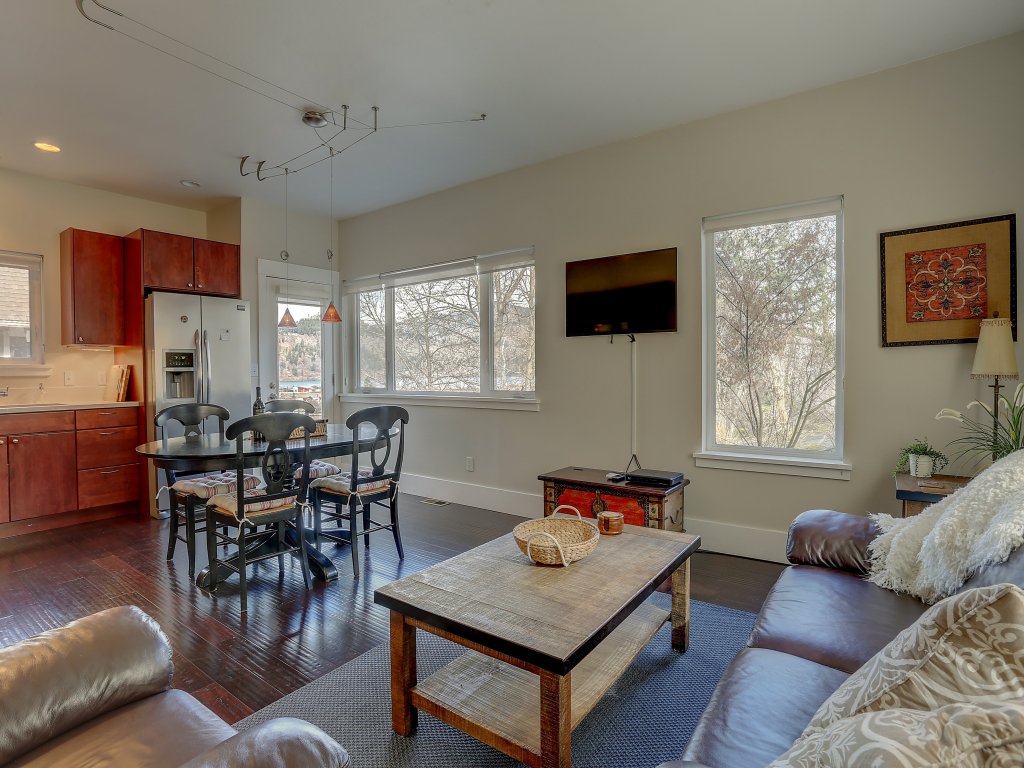
- Four flavors. Downtown — walking distance to pFriem, Full Sail, Double Mountain, Celilo, and the Event Site, lofts and condos with riverside or waterfront-park views, the dining-and-brewery-week classic. The Heights — the residential bluff above downtown with the Columbia-and-Washington-side panorama, family-pool-and-hot-tub homes a 5-minute drive from downtown. Riverside / Westside — a small set of larger riverside-or-river-adjacent homes 5 miles west of downtown near Westside Elementary and the Mt. Adams Heights overlook. Parkdale & Pine Grove — orchard-side homes 14 miles south on the Fruit Loop with Mt. Hood views, the slower-paced family-and-couples retreat option.
- How much does a Hood River vacation rental cost?
- Hood River is one of the more affordable Pacific Northwest small-town markets. Off-season (November–April excluding ski-peak weeks), 3-bedroom Heights pool homes run $145–$245 a night and 4-bedroom riverside homes $245–$395. Wind-season peak (mid-May through mid-September), the same units run $245–$395 (3-bed) and $395–$595 (4-bed). Ski-season weekends (December–March) push 4-bedroom homes to $345–$525. Many east-side and Heights properties offer monthly stays at a steep discount (30%+ off nightly rate) and several enforce 30-day minimums in shoulder seasons.
- Do I need a 4WD for a Hood River ski trip?
- Recommended in deep storm cycles, optional otherwise. OR-35 from Hood River south to the Mt. Hood Meadows turn-off (35 miles) is plowed and sanded by ODOT but sees overnight snow December–March; Meadows and Ski Bowl both require chains or AWD/4WD when the storm light flashes (about 8–12 days a winter on average). Timberline at 6,000 feet is steeper still — chain-up recommended on storm days. A standard FWD sedan with new winter tires handles most-day conditions; rent AWD if you're flying into PDX in January–February.
- Is Hood River good for non-windsurfers?
- Excellent. The Fruit Loop drive, the Mt. Hood Railroad scenic train, the Multnomah Falls and Bonneville Dam westside loop, the Maryhill Museum eastside loop, the brewery row, the Volstead Theatre, the Saturday Market, the Lost Lake and Tamanawas Falls hikes, and Mt. Hood's three ski areas give plenty to do without ever touching a sail or kite. Many couples-trips spend the morning on the Fruit Loop and the afternoon at pFriem watching windsurfers and never leave the riverside.
- What's the weather like in Hood River?
- Continental marine — warm dry summers, cool wet winters, with the famous Gorge wind year-round. Summer (June–September): 78–88°F days, 50–58°F nights, dry, 15–30 knot afternoon thermals. Fall (October–November): 55–70°F days dropping to 38–48°F nights; the Fruit Loop leaf peak is mid-October. Winter (December–February): 38–48°F days at downtown elevation, 28–38°F nights, periodic Gorge ice storms (Hood River sits at the wind-funnel pinch and gets the worst of it 2–4 days a winter). Spring (March–May): 55–68°F days, the orchard-bloom-and-windsurf-tune-up season.
- Are pets allowed on Hood River vacation rentals?
- About 35% of Hood River's RedAwning inventory is pet-friendly — filter for "Pets OK." Pet fees typically run $150–$250 per stay. Most Heights and Westside family pool homes have fenced yards. The Hood River Riverfront Trail allows leashed dogs the full 0.3 mile; Hood River Waterfront Park, the Old Columbia River Highway, and Lost Lake all allow leashed dogs; Mt. Hood Meadows doesn't allow dogs in the resort base; Multnomah Falls allows leashed dogs on the lower viewpoint but not the upper trail.
- Should I do Hood River or Bend?
- Different trips. Hood River is the wind-and-orchard town in the Columbia Gorge with Mt. Hood as the close mountain backdrop — windsurfing, kiteboarding, the Fruit Loop, the Mt. Hood Railroad, and the brewery row. Bend is the high-desert mountain town in Central Oregon with Mt. Bachelor as the close mountain — Cascade Lakes, Smith Rock, and a denser brewery scene. Pick Hood River if you want wind sports, orchards, and the close-to-Portland Gorge. Pick Bend if you want bigger mountain skiing, river-tubing, and high-desert sun. Or do both: Hood River → Mt. Hood → Bend is one of the great Pacific Northwest road-trip loops.